intraspace: the review lounge

Monday, November 05, 2007

The Picture of Dorian Gray

After reading almost exclusively non fiction this year I decided it was time to start reading some fiction. I had recently read about Oscar Wilde's the Picture of Dorian Gray in several places so thought this may be a good place to start.

The Picture of Dorian Gray tells the story of an extremely good looking young man who make a pact that enables him to keep his youthful looks throughout his life. Instead of him growing older the effects of his life and the effects of his sin are not seen in his body but in a portrait of himself.

Dorian under the influence of Lord Henry Wotton enters into a double life. While maintaining a respectable reputation within society he secretly begins a lifestyle in search of endless pleasures regardless of the cost. With each step further into a depraved life the only outward sign is the painting (that is carefully hidden in his house)becomes more and more aged and marred.

Wilde does have a way with words and their is some very clever and witty writing. At times I feel he gets a bit carried away with philosophical discussion between Lord Henry and Dorian. While some of these are quite amusing as Henry explains his hedonistic view on life, at times they are rather drawn out.

Overall this is a fascinating tale that looks at human nature, sin and the cost of living simply to pleasure oneself.

If anyone is looking to read this I highly recommend getting the Penguin Classic edition as it also includes some interesting articles written about how the book was received when it was released in the late 1800's

Labels: , , , , ,

Monday, October 22, 2007

war and peace

i did it. i read 'war and peace'. my cunning plan of reading the 'books' of war and peace interspersed with other books (to keep up my interest) paid off, and about nine months after starting, i finished.

my pleasant surprise was that war and peace is actually a cracking good book. it is such a vast and masterful work of art - combining the society intrigues of victorian novels (by austen and hardy etc) with gritty narratives about napoleonic warfare.

to quote tolstoy (from an article that he published about the novel), "I have spent five years of uninterrupted and exceptionally strenuous labour under the best conditions of life [on this work]." tolstoy doesn't hold back, and he achieves a work of grandeur that succeeds in holding the reader's attention through action and character studies.

my tactic of reading other books in between probably helped, but i actually found that i was pleased to get back to war and peace.

for tolstoy the reason for writing such a book was not mainly to entertain his readers. he had a theory about history that he was evidently very committed to demonstrating.

tolstoy says that war and peace "is not a novel, even less is it a poem, and still less an historical chronicle" [although it quite clearly contains elements of all these]. "War and Peace is what the author wished and was able to express in the form in which it was expressed."

the concept that tolstoy wants to communicate is this:

"The movement of nations is caused not by power, nor by intellectual activity, nor even by a combination of the two ... but by the activity of all the people who participate in the events... Morally the wielder of power appears to cause the event, physically it is those who submit to the power. But as the moral activity is inconceivable without the physical, the cause of the event is neither in the one nor in the other, but in the union of the two." (from the epilogue)

this is why war and peace has a cast of over 500 characters. each of them has a role to play in history, actions have ramifications. but at the same time the characters are also swept along by the events of history - participants and victims, as it were.

the only time when the narrative really slows in the book is at the end when tolstoy puts together all his thoughts about history in essay form, just in case the reader has missed the point. this break from narrative is a bit of an anticlimax but i suppose it is necessary given tolstoy's primary aims for the book. this ending shouldn't stand in the way of you reading it if you're not a history student - it comes at the very end as an epilogue, so doesn't interfere with the narrative.

all up, brilliant. highly recommended.

read more about 'war and peace' on wikipedia.

warandpeace-o-meter: finished!

Labels: , , , , ,

Saturday, May 19, 2007

modern art and the death of a culture

modern art and the death of a culture, by h.r. rookmaaker

looking on the title page of my copy of this book, i see i have dated it 1998 - which means that it's taken me almost 10 years to get around to reading it. the daunting and critical-sounding title made me wonder if i wanted to. i'm glad i did.

the field of christianity and the arts is beginning to grow these days (both academically and in practice), but 30 years ago most christians didn't want to touch modern art with a ten-foot barge pole. into that gap stepped francis schaeffer and his friend hans rookmaaker (a jazz critic and art historian). 'modern art and the death of a culture' was rookmaaker's major work in this area, and the lack of other writing by christians on this subject at the time makes his book a seminal masterpiece.

the book was published in 1970, just as modern art was climaxing - by that year, virtually everything that you could do in art (barring technilogical developments) had been done. this of course included some extreme and freaky work, but even at the less extreme end, people (especially the majority of christians) found contemporary art to be distasteful and abhorrent - many of them were still 'coming to terms' with modern art that had come out in 1910 (some of them still are).

rookmaaker's masterstroke was engaging with the art world rather than condemning it. in this book he heavily critiques modern art, but he mines out what he believes is essentially at the heart of the apparent destructiveness of it - a sense of loss and despair. and again, rather than condemning this fact, rookmaaker examines that this is the natural result of the process of humanism and the enlightenment. and so, he says, modern art accurately represents where western society has come to as a result of the enlightenment framework. he doesn't dislike modern art at all - he simply wants it to have more hope and beauty.

he argues that bourgeois niceness is not the answer - it is equally as bad, if not worse, than the negative elements of modern art. instead he challenges christians to meet the modern world where it is, and offer alternatives.

there is so much in this book, that i couldn't possibly summarise it all here - in fact what i have just written is really only my take on what rookmaaker is saying.

for me, what i found interesting was examining rookmaaker's predictions about the future as he saw it in 1970. i'm not an expert in this, but i think some of rookmaaker's predictions have come true, and on the other hand, i feel that the art world has stepped back from the precipice it was on the edge of in 1970. the main reason is that there is nothingness over the edge. and so the art world has struck camp 100 metres or so from the edge, and stretches back from there. if this is true, then we can see what modern art accomplished as being a true revolution, complete with violence and harm but in the end creating significant freedom.

the other great thing about the book is the challenge it lays down for christians - the challenge, as i have said, not to retreat into bourgeois niceness but to get out there and engage. i believe there is now a definite christian arts movement under way - i can see it gathering momentum even since the late 90s when i was at university - and i think rookmaaker would have approved. but his challenge still rings true and relevant.

for it's on-going relevancy and its historical importance, i think 'modern art and the death of a culture' should forever remain a crucial text in the tradition of christian cultural study and practice.

highly recommended.

on the headphones: 'attack el robot! attack!' by calexico, from the album 'feast of wire'.

warandpeace-o-meter: 553/981 (volII, bookX, chapI)


Labels: , , , , , , ,

Saturday, August 12, 2006

orthodoxy

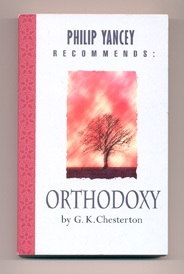
orthodoxy, by g.k. chesterton

if you've seen my other blog, you might have noticed that i've been harping on about g.k. chesterton recently. i've finally finished reading his book 'orthodoxy'. it looks little, like a quick read, and then it isn't.

this book seems to have had a revival in the last couple of years. it's recommended by philip yancey (as you will see from the cover of my copy), john eldridge mentions it a lot in his writings, and relevant media (purveyors of christian cool) have just released a version under their imprint. i suppose it was also considered a 'christian classic' before this recent press - i've heard that it was instrumental in bringing c.s. lewis to faith.

the book was first published in 1908. there are aspects of it that seem a bit dated in 2006 (his examples more than his arguments). i found it a bit hard to get into for the first couple of chapters, but it took off after that. there were certain passages that were that kind where you stop reading for a couple of minutes because they are so powerful and they take some processing.

while chesterton's arguments are often quite compelling, i found it just as useful for stimulating my own thoughts and ideas. the book is in the same category as writing by c.s. lewis if that's your cup of tea.

on the stereo: 'everyday should be a holiday' by the dandy warhols, from the album 'come down'. www.dandywarhols.com


Labels: , , , , ,

Saturday, June 24, 2006

the murder of roger ackroyd

the murder of roger ackroyd, by agatha christie

anna is a huge fan of agatha christie and has read pretty much everything that aggie wrote. i, on the other hand, hadn't read anything by the queen of murder mystery.

it is pretty widely accepted that 'the murder of roger ackroyd' is agatha christie's finest work, so i thought that if i was going to read one it might as well be this. there's a book out at the moment called '1000 books to read before you die' and this book makes it onto that list.

obviously the story has all the hallmarks of 1920s, 1930s murder mystery - a rich murdered man, a suspect butler, a former british officer, a beautiful young woman and no end of household intrigues that act as red herrings to the main mystery. there are also the obligatory gatherings in drawing rooms to probe suspects and so on. the investigation in this story is carried out by agatha christie's famous hercule poirot.

there is no doubt that christie was an excellent writer. in this book she writes in first person from the perspective of a male doctor. that is largely convincing, but when people write as members of the opposite sex it doesn't always ring true.

it was a good book, and i really enjoyed it. i'd say it was a good option for my one big murder mystery reading. i won't give away the plot twist that this book is famous for - even if the story is nearly 80 years old.

on the headphones: 'bulletproof' by morcheeba, from the album 'the big calm'. http://www.morcheeba.net/


Labels: , , , ,

Wednesday, April 26, 2006

the screwtape letters

the screwtape letters, by cs lewis

cs lewis strikes again! not that i should be surprised, he is widely regarded as one of the best christian writers of the 20th century.

this book is the record of letters sent by senior demon screwtape to his nephew wormwood. wormwood is on assignment trying to turn a new christian away from God. the more experienced screwtape gives advice to the young demon. this in turn gives us an insight into the way humans are deceived and tempted.

it's astonishing when you take stock of lewis's total literary output to realise just what a genius this man was. he has left an indelible mark on christian thought quite possibly for all time. he was a man of incredible intelligence and insight.

and so, true to form, this book is really brilliant. and, unlike some of his books, easy to read. not least of all because of the subplot of the human subject that screwtape and wormwood are trying so hard to mislead. you get to know not just the demons' methods but also some of the character and backstory of the man. the individual letters are short and interesting, and perception altering.

i'll add this to my list of crucial christian books.

on the headphones: 'everyday' by the cinematic orchestra, from the album 'every day'. http://www.cinematicorchestra.com/

Labels: , , , , ,

Saturday, December 03, 2005

miles: the autobiography

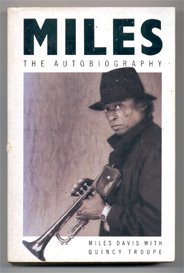
miles: the autobiography, by miles davis and quincy troupe

this is a classic of jazz writing. and while i'm reaching for superlatives, can i also say that it is pretty much an essential read for anyone interested in jazz?

miles davis was apparently quite well-known for getting details wrong, but even if every detail in this book isn't entirely accurate, it still gives great insight into the jazz world he inhabited.

nearly every famous name in jazz was associated with davis at some point in their career, and his life spanned pretty-much every jazz movement from big band to acid jazz, although this account ends before the last couple of albums he did.

now, as for the writing itself, the text sounds like miles sitting down and rabbiting off his recollections (although i'm sure putting the book together was actually a bit of a nightmare for quincy troupe) and that works well. the book is somewhat famous for the way it liberated the word motherf****r - miles found ways to use it in every conceivable way. so if your ears burn, then this might be a struggle. not only that but miles comes across as a tiny bit racist and sexist - i'll leave it up to you to decide how much irony i'm using in the words 'tiny bit'.

gladometer ('how glad am i that i read it?') rating: pretty glad.

on the headphones: 'into the ocean' by evermore, from the album 'dreams' (not jazz by the way).
www.evermoreband.com

Labels: , , , , ,